LYNN BERGMAN: N.D. EDUCATION SHAKEUP CRITICALLY NEEDED
Background Information:
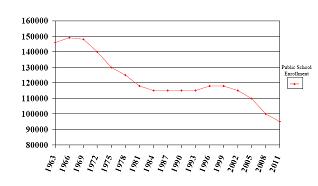
North Dakota Public School Enrollment 1963-2011
________________________________________________________________________
Changes in K-12 Education over the last 10 years
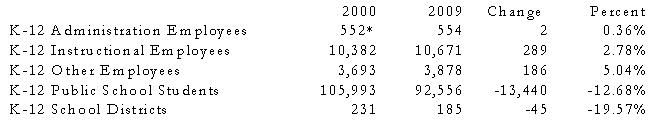
* 2001-2002 was oldest data available on DPI website
Higher Education
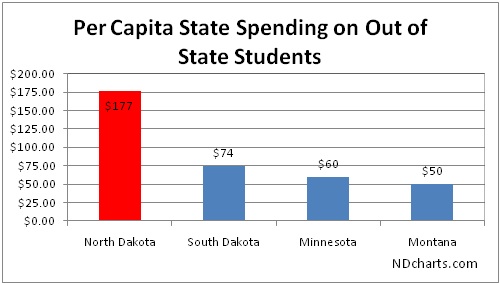
Per capita North Dakota spending on out-of-state students is currently about $177. The contrasting numbers for South Dakota and Minnesota are $74 and $60. So North Dakota spends 2.4 times as much per capita as South Dakota and 3 times as much per capita as Minnesota on out-of-state students.
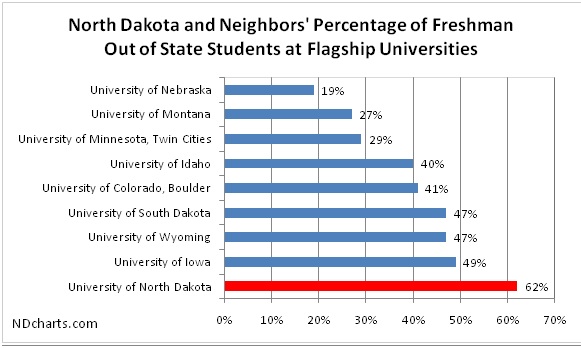
62% of freshman at UND are out-of-state students as compared with 47% and 29% for USD and the U of M respectively.
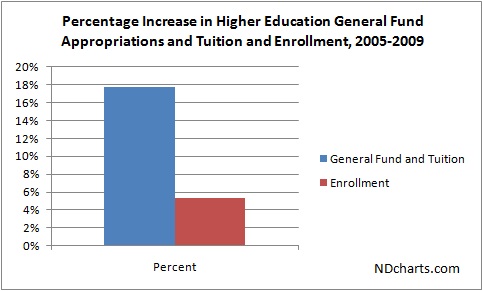
North Dakota higher education received about 18% more revenue from the general fund and tuition combined from 2005 to 2009, while enrollment increased about 5%. So spending is increasing at a rate 3.6 times enrollment.
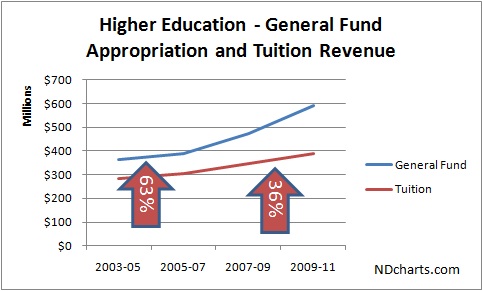
North Dakota general fund appropriations to higher education increased 63% between 2003 and 2011, while tuition revenue rose 36% over the same time period, both far exceeding the rise in the inflation rate (Midwest CPI-U) of 18.7%.
North Dakota has more four-year public colleges in relation to the population than any other American state, including such other low population density states as Montana, Wyoming, South Dakota and Alaska.
Summarizing, we spend 2.4 to 3 times more per capita than our neighbors on out-of-state students, spending is increasing 3.6 times increases in enrollment and 3.4 times the rate of inflation, and tuition is increasing at near twice the rate of inflation. And we have more four year institutions per capita than any other state.
K-12 Education
K-12 enrollment in North Dakota in the mid 1960’s was near 150,000. Projected K-12 enrollment for the 2010-11 school year is about 95,000 students. So we have about 37% less K-12 students than we did in the mid 1960s.
The number of administrators has held constant at just over 550 while enrollment fell from around 118,000 to around 95,000 during the last decade.
Summarizing, during last decade, the number of administrators has held constant while the number of students enrolled fell by 20%.
Testimony:
Chairman Koppelman & members of the House Constitutional Revision Committee.
My name is Lynn Bergman. I am a UND alumni and a retired civil engineer residing in Bismarck. I am testifying today as a taxpaying citizen. I first would like to place some emphasis on North Dakota higher education and K-12 economic parameters.
North Dakota Education Facts
Regarding higher education in North Dakota, we spend 2.4 to 3 times more per capita than our neighbors on out-of-state students, spending is increasing 3.6 times increases in enrollment and 3.4 times the rate of inflation, and tuition is increasing at 2 times the rate of inflation.
Regarding K-12 education in North Dakota, during last decade, the number of K-12 administrators has held constant while the number of students enrolled fell by 20%.
These facts are troubling to me and should be of concern to every taxpayer in North Dakota. They point out serious economic mismanagement of both K-12 and higher education. So I applaud this effort to change the status quo regarding the administering of education services to the citizens of North Dakota. And I have a few suggestions to make this ballot measure more palatable to the legislature as a whole.
Economic Mismanagement of Education in North Dakota
The causes of the economic mismanagement are not quite so clear and transparent as the facts I have shared with you.
The “structural” problems inherent in North dakota’s education system begin, I believe, with the oligarchic nature of the Board of Higher Education and the excessive tenure of the Superintendent of Public Instruction.
Board of higher education members are appointed by the governor, are generally re-appointed when they desire to continue on the board, and are curiously immune to removal by the governor. Three members are attorneys, two are professors, one is a student representative, and one is a retired realtor. Only two of the members have legitimate management experience, one as a bank administrator and another with the North Dakota National Guard. So it should be to no-one’s surprise that the board has tended to ignore big picture issues such as extravagant out-of-state student subsidies, tuition increases that greatly exceed the cost of living, and excessive spending on brick and mortar, as perhaps best exemplified by the competition between the two research universities to build the most opulent “presidential palace”.
While the current structure of the Board of Higher Education is likely intended to provide direct representatives of the “people of North Dakota” a voice in the affairs of higher education, I believe that the structure only provides a voice to the “higher education oligarchy”. Members of the board are “courted” by the “education oligarchy” in a manner that would be seen as “unseemly” to most ordinary citizens of our great state.
The Superintendent of Public Instruction, while an elected position, has been filled by the same individual for 26 years.
A Taxpayer’s Suggestion for Structural Change
It would be very beneficial to good government if ALL communications between the governor and his cabinet, the university system chancellor, and the university system presidents would be public. For that reason alone, I believe that the current outmoded “citizen representation” on the Board of Higher Education should be abolished. But it is at this point that I part ways with this legislation.
An Updated Structure for the Board of Higher Education
I believe a far more effective and accountable Board of Higher Education would consist of each of the university system presidents as directed and coordinated by the chancellor of the university system. Meetings would be quarterly at a minimum, preferably monthly, and very open to the public, providing space for up to 50-100 interested citizen observers. Detailed committee assignments could be assigned to the appropriate subordinates of the system presidents either working together or individually, depending on circumstances.
This transformation from a “citizen board” to an “optimally accountable board” would, I believe, promote the transparent and open discussion of issues such as costs, growth, and viability of individual educational programs as well as very public discussions toward paring down “wants” and “needs” to what taxpayers desire…only the bare “essentials” necessary to provide the highest quality of education that is in line with the expenditure of a minimum of our state’s fiscal resources while limiting tuition increases to the cost of living.
I believe the Presidents of the two research universities to be overpaid under the current system but that they would likely earn their current pay with the new responsibility to replace the citizen members of the current board of higher education, holding themselves up to public scrutiny in a very transparent public format.
Regarding the chancellor position, I do not believe this position to be best served by a lawyer. The pay provided the position should allow the selection of the highest level of education administrator to oversee the new board consisting of the presidents of the various institutions. Over the years, I would envision the chancellor position being filled by the most effective and respected of the individual institution presidents on the board.
I also believe the Department of Public Instruction should not be “over politicized” as it has been for so many decades, causing undue polarity between school boards and teachers. So I do agree with dissolving the elected superintendent of public instruction position and making the job a cabinet level one with direct accountability to the governor and in direct partnership with the higher education chancellor.
With these few changes to this proposed ballot measure… and with the passage of separate legislation to prohibit the use of state resources “in opposition to” or “in support of” ballot measures, I believe that North Dakotans will welcome these changes in the methods of administration of education in our state. Thank you for your attention.

 DakotaBeacon